


The History and Evolution of ABA Therapy

FEATURED POSTS


September 11, 2026

July 29, 2026

Applied behavior analysis (ABA) is one of the most widely used and most debated approaches to supporting individuals with autism. Many professionals and families consider it a leading, evidence-based intervention, while a growing number of autistic self-advocates have raised serious criticisms of how it has been practiced. Both perspectives belong to the same story, because ABA today looks very different from the ABA of the 1960s.
Key Takeaways
- ABA is the science of learning and behavior.
- In autism services, it has been used since the 1960s and remains widely used today.
- The field was formally defined in 1968 by Baer, Wolf, and Risley, whose seven dimensions still guide quality practice.
- Early intensive programs, including Lovaas’s work, were often rigid and sometimes used aversive techniques that are now widely rejected.
- Criticism from autistic self-advocates has pushed the field toward more naturalistic, respectful, and individualized practice.
- Contemporary ABA emphasizes person-centered, assent-based, neurodiversity-informed care, with the family and individual helping set goals.
- When choosing a provider, ask who sets the goals, how individualized the program is, and how the team builds in assent and family input.
Understanding how the field of ABA has evolved, including the criticism that drove much of that change, helps families make informed decisions and helps the field keep improving. This guide traces the history of ABA, why earlier forms drew criticism, and what contemporary, person-centered ABA looks like now.
What Is Applied Behavior Analysis?
ABA stands for applied behavior analysis. At its core, it is the science of learning and behavior, and as a therapy its purpose is to help people build meaningful skills and reduce behaviors that interfere with growth and learning.
ABA studies how behavior is shaped by the environment, especially by what happens before a behavior (antecedents) and what happens after it (consequences). The basic idea is that behavior followed by meaningful reinforcement tends to increase, while behavior that is not reinforced tends to fade. These principles are not unique to autism. The same science appears in classrooms, workplaces, sports coaching, and even animal training.
In autism services, ABA is used to help individuals build communication, social, play, and daily living skills, and to reduce behaviors that interfere with learning or safety. For a closer look at how the field describes its current form, see our overview of contemporary ABA.
Where Did ABA Come From?
The roots of applied behavior analysis (ABA) reach back more than a century. In 1913, the psychologist John B. Watson helped launch behaviorism, arguing that psychology should focus on observable behavior rather than only on internal thoughts and feelings. Decades later, B.F. Skinner expanded this work through the study of operant conditioning, describing how consequences shape behavior over time and laying much of the groundwork for the field.
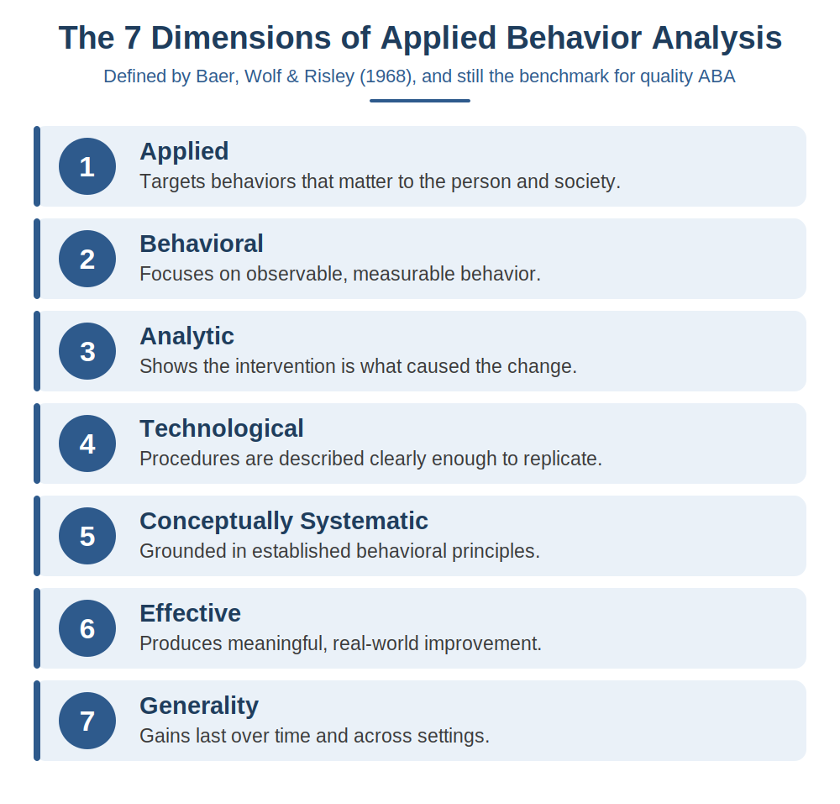
ABA was formally defined in 1968, when Donald Baer, Montrose Wolf, and Todd Risley published the founding paper that named ABA’s defining features in the first volume of the Journal of Applied Behavior Analysis. They outlined seven dimensions of quality applied work, including that it should be applied, behavioral, analytic, and effective. Those dimensions still guide the field today, which means ABA has existed as a defined field for more than 50 years, with roots in behaviorism reaching back over a century to 1913.
Around the same period, Dr. O. Ivar Lovaas began developing intensive behavioral programs to teach language and other skills to children with autism, with the goal of helping them learn and avoid institutionalization. His widely cited 1987 study reported that many children who received roughly 40 hours per week of early intensive intervention made significant gains. That research helped popularize ABA as an autism intervention and launched many early intervention programs, often built around repetitive discrete trial teaching at a table.
The seven dimensions Baer, Wolf, and Risley described still define what quality ABA looks like today:
Why Was Early ABA Criticized?
The early popularity of intensive ABA also created problems that the field is still reckoning with. Many early programs were highly structured and adult-driven, delivered for exhausting numbers of hours. Some programs, in keeping with the era, used aversive techniques, meaning unpleasant consequences intended to reduce behavior. Those methods are now widely rejected, and current standards call for the least intrusive, evidence-based approaches.
More recently, a generation of adults with autism who received earlier forms of ABA has spoken out. Some describe lasting distress and trauma, and many criticize goals aimed at making autistic people appear less autistic, such as suppressing harmless self-soothing movements or requiring eye contact that can feel physically painful, rather than goals centered on the person’s own well-being.
These concerns, examined in peer-reviewed analysis of the criticism and in the broader neurodiversity movement, deserve to be taken seriously. At the same time, many families and autistic individuals report meaningful benefits from ABA, especially when it is individualized and consent based. Holding both of those truths at once is part of practicing responsibly, and it is a large part of why the field has changed.
How Has ABA Evolved?
Since the 1970s, ABA has changed substantially, much as other areas of healthcare have changed with new research. Rigid, clinic-based drilling has given way to more naturalistic, play-based, and child-directed teaching. In natural environment teaching (NET), for example, learning happens during everyday routines like mealtimes, play, and community outings rather than only at a table. Newer naturalistic and developmental models blend behavioral science with what is known about how children naturally learn and develop.
The deeper shift is philosophical. Contemporary ABA emphasizes person-centered planning, in which the individual and family help choose goals that fit their values and culture, and assent-based care, which means paying attention to a person’s willingness to participate and treating resistance as meaningful information.
The current BACB ethics code calls on behavior analysts to treat individuals with compassion, dignity, and respect, and to use the least intrusive, evidence-based procedures suited to each person. Much of this evolution has come from listening to autistic voices, a process described in how neurodiverse voices are influencing the evolution of ABA.
How Can You Tell If a Provider Uses a Modern Approach?
Because the term ABA now covers a wide range of services, it helps to ask questions before choosing a provider. Useful questions to ask include:
- Will I help decide the goals of my child’s program?
- How individualized is each program, or do all clients receive something similar?
- How is my input, and my child’s, built into the plan?
- How often is the program reviewed and revised?
A provider practicing contemporary, person-centered ABA should welcome these questions rather than avoid them. Our Q&A about ABA therapy walks through more of what families can expect and ask.
How LEARN Practices Contemporary, Person-Centered ABA
LEARN Behavioral describes its approach as contemporary ABA: an evolved practice committed to person-centered, assent-based care. That commitment is structural, not just aspirational. LEARN created a person-centered ABA workgroup of clinical leaders to guide a neurodiversity-informed approach, along with a Neurodivergent Advisory Committee that brings autistic and neurodivergent perspectives directly into how services are shaped.
In day-to-day practice, that means individualizing goals around each person’s strengths and interests, incorporating family input, and listening when an individual signals that something does not work for them. Behavior analysts design and oversee each program, and behavior technicians deliver much of the direct support, with the goal of care that respects the whole person.
Frequently Asked Questions
What are the seven dimensions of ABA?
In their 1968 founding paper, Baer, Wolf, and Risley described seven dimensions of quality applied behavior analysis: applied, behavioral, analytic, technological, conceptually systematic, effective, and generality. In plain terms, the work should target meaningful behaviors, measure them objectively, show that the intervention is what produced change, be clearly described, rest on established principles, make a real difference, and hold up across settings and time. These dimensions still serve as a benchmark for quality practice.
Is ABA therapy used only for autism?
No. The science of behavior that underlies ABA is applied far beyond autism, including in education, organizational management, sports coaching, health behavior change, and animal training. In autism services specifically, ABA is used to help build communication, social, play, and daily-living skills and to support safety and learning.
What is assent-based ABA?
Assent-based ABA means paying close attention to whether a person is willing to participate, not just whether a parent or guardian has consented. A learner’s signs of distress or refusal are treated as meaningful communication rather than behavior to push through. This approach is part of the broader shift toward respecting autonomy and dignity in contemporary practice.
Is ABA evidence-based?
ABA-based interventions are supported by decades of research showing gains in communication, social, and adaptive skills, which is why they are widely funded by insurers. At the same time, researchers and autistic advocates have noted limitations in some of the older literature and have called for higher-quality studies and outcomes that reflect what people with autism value. Both the evidence and the ongoing critique are part of an honest picture.
How many hours of ABA therapy are typical?
It varies by individual and goals. Focused programs that target a few specific skills often range from about 10 to 25 hours per week, while comprehensive programs can range from roughly 30 to 40 hours per week. A behavior analyst recommends a level of support based on the person’s needs, and the plan should be reviewed and adjusted over time.